


SPECTATORS
Odd as it may sound, many people are spectators. They know this but pretend as if it’s not the case.
Chukwugozie and Okechukwu were born to the same parents. The boys were to cause a strong revival in their community, with the help of its other indigenes. Many knew about their birth and their calling, both in their land and in the world beyond them.
Between the boys, the question of who would be the actual deliverer of their community and who would be the destroyer was contentious. Most people in the community were religious and so they got a lot of spiritual information. Their information was mostly from their local deity or from Chukwu, the creator of the universe. In order to discover which of the boys would be the deliverer, the people visited their home regularly. Though the boys were twins, they didn’t look identical so it was easy to differentiate between them. Chukwugozie was born first. Okechukwu followed. For that reason, it was first assumed that Chukwugozie was the deliverer.
Resulting from the assumption that Chukwugozie was to be the deliverer, people initially showed more favour towards him, especially in presenting gifts, with the hope that when he reigned as the deliverer, he would reciprocate their gestures in kind, possibly marrying one of their daughters. The boys were the talk of the town; people couldn’t have a conversation without mentioning either of them. As they grew, Chukwugozie began to have visions of the spiritual world. It started at the age of five and frightened him. Most times, he wondered if he was normal or whether a curse had been placed on him. One day, he saw things that were beyond his understanding so he ran to his aunt, who lived in their family house.
When Chukwugozie’s aunt heard his story and saw the fright on his face, she smiled and told him not to worry, saying that it was common in the Ndi Ofú community and that it was the work of Chukwu, to notify the deliverer and to help rescue the people from impending troubles. “Troubles?” the boy asked. “What kind of troubles?” “…Troubles that are too enormous to bear and countless in number”, replied his aunt, Nneka. “Just rest and with time you will know how to handle and use your gift for good.” Those were her words before she tucked him back in bed. She wondered if Chukwugozie could be the deliverer but as she lay down to sleep, she decided not to tell anyone; not even the boy’s parents.
Troubles! Were there really troubles? Yes, in Ndi Ofú community, there were countless problems people couldn’t mention, like ritual killings for money and power, cannibalism, fraud and all sorts of deception for personal interests, oppression of the poor masses and of the less-privileged in the society, injustice for those who sought fairness and much more. The people cried to Chukwu continually for their land to be redeemed and for Him to raise a deliverer to sustain transformation whenever it occurred.
Most of Ndi Ofú’s rulers were complacent. They cared little about the happenings in their community. Whenever they were elected, they went after their selfish desires and ignored those who sought their assistance. They denied justice to the less-privileged but allowed accused people to go free after collecting bribes that they requested. Those corrupt acts lingered and most people in the community were scared to speak out, for fear of what might happen to them if they did.
The silence of Ndi Ofú’s people was similar to sitting on the fence and watching what was unfolding. Things became so serious that their problems started telling on them. It was not just physical anymore but also spiritual. Some of the people started losing their gifts of seeing visions. Some couldn’t communicate with Chukwu freely anymore and some started practicing diabolical things to have a hold on some power. The wise ones resorted to praying in their closets for the land’s deliverer to arise.
It was quite ironic that the Ndi Ofú people; “people that see visions”, as their name implies, were going through sufferings. Could it be that they were hearing from the wrong god? The truth was that their visions and their interpretations of them were based on the states of their hearts at any given time that they were received. One could get the truth through a vision for the land or a vision for oneself, others or a particular group of people but their interpretation was determinant on whether hatred, bitterness, jealousy, selfishness, malice, lustful or other bad thoughts were lingering in their hearts. An example was the situation between Uzochukwu and Ginika, who were in a relationship. Many times, Uzochukwu would impress Ginika with some truth about happenings in their community, as revealed by Chukwu, as well as with talks on the possibilities of a future for them together. That made Ginika fond of Uzochukwu but the young man became lustful and he convinced her to have sex with him, considering that they were going to marry. After the act, he dumped her and that made the girl confused and insecure, doubting all others who approached her after Uzochukwu, whether or not they claimed to know Chukwu.
Was it that the Ndi Ofú people didn’t know what they were doing? In actual, there were three categories of people in the community: the sheep, the wolves and the wolves in sheep’s clothing. The Sheep were the innocent ones; some were knowledgeable on visions and they interpreted them for the good of people around. Some others were clueless about such. Some did their best to live rightly while others were reckless, making them instruments for evil people. The Ndi Ofú community had a mixture of such people. Most of the Sheep longed to do what was right but their fears limited them so they resorted to prayer, for Chukwu to raise a deliverer from among them.
The wolves had no fear of Chukwu; they were out for their selfish agenda. They used all sorts of things to either manipulate others to do what they wanted or to destroy them for their own benefit; they were rebellious in nature. They did not want to have any association with Chukwu or people who were committed to Him, even when they knew Chukwu was above all. They tried to rub shoulders with Him.
The wolves in sheep’s clothing were those who had ulterior motives for their good actions. They pretended to give a helping hand just so that they could get what they really wanted in the long run. They could claim to have a deep knowledge of the mysteries of Chukwu, to draw a crowd to themselves but it was all deception; they were neither here nor there; they camouflaged themselves according to what was suitable at every moment.
Chukwu, who is ever faithful, answered the prayers of Ndi Ofú. He told them about the family through which he would deliver Ndi Ofu. That was where the matter of Chukwugozie and Okechukwu came to play because their family was pointed at by Chukwu, as the one that would raise the deliverer for Ndi Ofú community’s problems. As the people watched the boys, Chukwugozie seemed more likely to be the deliverer; he was more concerned with the things of Chukwu; he was a well-behaved young lad and one who sought deep spiritual truth, unlike his brother who was stubborn and rebellious, with no care for spiritual matters.
As people spoke about the future and what might play out, it seemed they knew it all but all they knew were bits and pieces. They gathered many followers to themselves. They speculated that in the house of the deliverer, one child would be good and the other bad. Most of the good people couldn’t do much but wait for the deliverer to be revealed; they observed to see which of the boys would be good and which one would be bad. It was not easy to tell though because Okechukwu was transforming as he was coming of age.
In order not to be misguided, the Ndi Ofú people made the two boys leaders in different areas in the community. Both boys provided leadership independently. The aim was to observe them separately. If any of them declared something as a prophecy from Chukwu, the people would see if it came to pass. When one of the boys was seen to be right, the people moved towards that one as though he was the deliverer. When a prophecy made by the other came to pass, the people shifted again towards him. It happened regularly.
The wise ones among the Ndi Ofú people sought after Chukwu, rather than wait for the deliverer. The more they sought after Him, the more He revealed Himself to them and spoke to them through visions, dreams, and into their hearts. As they were guided by Chukwu, they began to teach people how to hear from Him and how to interpret visions they received from Him. It was challenging for them because they were not getting immediate results but they kept at it, believing that it would eventually yield fruit.
The influence of the bad people in the land increased and so at a point, Okechukwu stepped down from his position and went to a nearby country to learn why his community was failing, in spite of the gifts his people were endowed with. Unknown to him, he couldn’t learn or understand things from another land because his land was peculiar. The burden of leadership became too much for Chukwugozie. When most people expected more from him as the supposed deliverer, he ran away and settled in another land. There, he got married. He and his wife had children and were away from the watchful eyes of the people of Ndi Ofú.
It seemed as though all hope was lost for the Ndi Ofú people. Evil continued unabated and expanded all around the community. The only people that withstood and opposed evil were the wise ones and their followers. The Ndi Ofú people wondered among themselves whether the prophecies about a deliverer were true after all. “Did Chukwu lie? Is there really a deliverer?” they asked. Some gave in to evil practices. Some others sat back and watched. Many people either did good or bad; whichever was favourable at any moment. A few others joined the wise group and their number increased.
While Okechukwu was away, he realised there was not much he could get towards providing a solution to his people’s problems so he returned home. Upon returning, he observed that things had gotten worse and were unbearable. What could he do? He found help in the company of the wise ones among the Ndi Ofú people. They taught him a lot of things, such as how to hear from Chukwu, how to discover his gifts and talents and how to use those gifts for the good of the land. As time went on, Okechukwu gained mastery of the abilities he had acquired and he began to train his people on leadership. He told the people that Chukwu had an important role in the transformation of the Ndi Ofú community. People began to accept his teachings and to trust Chukwu to fulfil His word in their lifetime.
When it looked like their misery was over and a ray of hope was beginning to appear, the wicked people ganged up and accused the good leaders of responsibility for the problems in the community, bringing about a division among the people. It brought about a setback for Okechukwu and his followers because some gains in receiving their trust were lost with the accusations, especially among the followers who were never really sure about what to do. Those followers were not steady. They would support one person and follow them for some time but in another moment, they would change their minds.
Okechukwu collaborated more with the wise people in the land. He called on his brother, Chukwugozie, to return to the community. They worked out a plan: the wise people did what they knew best, Okechukwu continued his role of training leaders and Chukwugozie taught people on how to interpret and utilise the visions they received from Chukwu. It was a three-fold cord that could not be broken. They began to expose the wicked acts of the wicked political officials in the land, holding them accountable for their actions and removing those who were unfruitful in their jobs, especially the influential ones who got their wealth from unlawful practices. Such wicked people were questioned thoroughly.
People in Ndi Ofú began to sit up because they didn’t know who was watching them, to bring them to book. Those who would have naturally done evil began to do good and those who always desired to do good, did it freely. All like a dream, Ndi Ofú community changed for good with people marvelling at its accomplishments and how Chukwu transformed it to what it eventually became.
Written
By
Ikenna I. Anyadike
Edited by Chukwudifu Onianwa, of ChuDifu Projects
Share:
“Drop Something” Syndrome
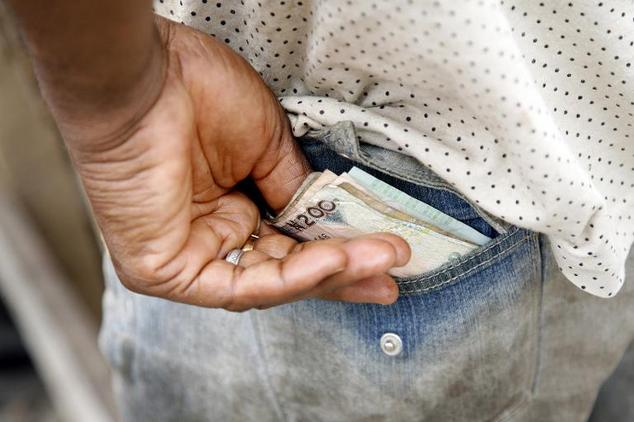
When did soliciting for tips, and various monetary favours from strangers, become a norm? In Nigeria, the culture seems to have taken root. A customer may finish transacting business somewhere and get requests from members of staff at that location, for some form of personal gratification. It’s amazingly shameful! The people that make these requests are often salary-earners at the places where they make these shameful requests. Why can’t they live through decent means? They embarrass their employers and those customers who they trouble for those favours. It’s particularly bad in urban places like Lagos, though residents in some rural communities also engage in that disgraceful practice.
One day, I had a funny experience with that. I had just left a supermarket where I had gone to do some shopping. I was wondering if I had spent more than I should have. My concern was about having enough money for the next day. A small boy who worked at the supermarket was asked to help me take my refilled water dispensers to the car. As he finished loading the items into the car, he mumbled something that I couldn’t make out. He repeated it clearly when I asked: “Your boy dey here; anything for us?” “What do you mean?” I asked in a harsh tone. He quickly realised I wasn’t the sort of person with whom he could get away with that and so he ran off, like a child whose mum was approaching him with a cane, to flog the living daylights out of him.”
I tried to guess the boy’s age from his appearance. He was probably twelve; maybe thirteen or fourteen. At best, he would have been fifteen. To have a boy seeking such favours at such an age is worrisome. Interestingly, he couldn’t have worked at that supermarket beyond two weeks because I would have noticed him before then if he did. I shopped at that location regularly. Seeing the boy seek monetary gratification outside his salary, for work he is paid to do, is something hard for me to wrap my mind around.What a mess! What would one expect from him when he is in his twenties, thirties or forties?
The behaviour of seeking unearned gratification is spreading like wildfire. A former classmate of mine visited another African country and got a negative impression because of the frequent requests for tips at almost every opportunity. Why should our African brothers embarrass us in the view of foreigners? Does it have to get to that extent? I know that it happens because years ago, during my travels, when I went through screening at the international airport, it was normal to hear things like “Chairman, drop something for us”, “Put 100 USD inside the bowl”. I would simply smile and walk away but really… 100 USD? Are you joking? They’d expect me to hand them money they didn’t work for, just like that? Money whose source they didn’t know! Money they’d squander quickly, as they didn’t work hard for it!
The “drop something” syndrome comes in different variants. There are the executive, the business, the religious and the layman variants. Learn about these so that you can identify them when they present themselves.
The executive variant has executive beggars– salary earners who make money in addition to their salaries, through undignified means. You would find them at banks, malls, airports and restaurants, among a few. They are low-wage workers such as security personnel, waiters and various assistants. Their typical greeting is “Happy weekend, sir (or madam)!” even when it’s midweek. Occasionally, they’d say, “Big boss, your boy dey here o!” Ridiculous!
The business variant has a fraudulent base. Some people would pretend to be human resource consultants or claim to have a formal relationship with some human resource people and would attempt to scam their targets, offering them make-believe jobs and contracts. These job and contract offers are unsolicited but carefully targeted at those they believe would easily be swayed into offering money for those opportunities. One group of people that they target is those who have recently been discharged after completion of the NYSC programme. Business variant members of the drop something club would fish for names of past NYSC enrolees, using the NYSC magazines. With the high unemployment level, they would likely be successful at scamming a few of them.
This group of scam artists would lure their victims with promises of jobs and invite them for tests or interviews, to raise the hopes of their targets. Upon succeeding in drawing the attention of those ones, they would present them with an offer, on the condition of receiving some money in advance, as appreciation or money that they claim would be used to settle some ogas at the top.Sometimes they would extort such money in various amounts over a period of time, for various false causes. If their target isn’t careful, they could suck them dry before they realise that there is no job available.
The religious variant is seen with people who don’t fear God. They play on people’s emotions, positioning themselves in bus parks, claiming to be men of God; so-called preachers. As the bus is about to be full, they would get down from it and begin their so-called ministry. I say so-called because their message does not add up. They have no real message. Their aim is simply to stir emotions for their benefit, with the aim of provoking their audience to give money to them. After four to five minutes of speaking, they’d ask for an offering. This situation is prevalent in rural areas and can sometimes be seen in marketplaces.
The layman variant is perpetuated by people who seem to have studied in a school for tricksters. They are very crafty. Some of them would present themselves as common people without work or would pose as people who are stranded on the road. You’d find these ones all over the country and their chat lines are similar. There are, of course, different grade levels with these people; the lower and higher classes. The lower ones are often seen begging for alms in traffic but they have no form of physical deformity. The higher class ones are well-dressed and speak good English.
The higher class layman variant of the drop something club occurs where it is difficult to interrupt their business; in estates, houses of worship and market places, for example. Some of them have approached me in the past, in different places. Typically they’d say something like, “Excuse me, sir; please don’t be offended. I know you don’t know me from any place. I feel ashamed to talk to you about this…in fact, you are a man like me…you know how much courage it takes to talk about a thing like this…” “…some people will embarrass me; that’s why I came to you…” What would follow would be a story that culminates in a request for money because he is stranded, with no money for transportation.
Wonderful! Let’s consider the points:
“Don’t be annoyed”. Why would I be annoyed if he approached me?
“I know you don’t know me from any place”. That’s obvious.
“I feel ashamed…you are a man like me…you know how much courage it takes…” Why should he attempt manipulation in order to get his way?
“Some people will embarrass me; that’s why I came to you…” Why should he attempt to play with my emotions and patronise me? What’s special or different about me, really?
Most of these people repeat themselves. One day, I was taking a walk and one approached me. After spending time trying to sway me emotionally, I cut him short and told him to cut to the chase. He started all over, like an audio recording that was played, stopped, rewound and replayed. Amazing! I had no option than to hear his repeated whining. Interestingly, this person who claimed to be in need of transportation was not dressed as someone ready to leave for another location; he was dressed as someone who was within his environment. Even more curious was the fact that within the vicinity where he was asking for money, there was no means of public transport. It was a residential close. Was he requesting for transportation money to enable him walk into his house nearby?
Another encounter between me and a layman variant of these people was very dramatic. I was in a hurry to meet up with an appointment when he came towards me from the opposite direction. I was driving. His smile, as he approached, suggested he knew me. It seemed, at first, that he was going to warn me of impending danger. I wound the window of the car down and he cut to the chase: “I need money for transport to…” Before he could finish, I wound back my window and drove further along as traffic continued. Funny as it may sound, hours later, I saw the same guy. I wound down my window and this time gave him enough to take him wherever he might have wanted to go. Did he stop there? No. Forgive the expression but a dog always wants more meat; bigger meat. He walked up to a lady in a big SUV, to ask for money again. I hope she gave him what he deserved; a big NO!
Am I suggesting that there are no genuine and honest people going about seeking help from others? Definitely not! There would be those who genuinely use what is given to them for the purpose for which they ask. Some really are stranded and in need of help so we would do well to give assistance when we can. To however have this situation where around every corner, someone wants people to drop something,is not excusable. People should look for legitimate ways of earning an income. They should not look for easy escape routes but should use their skills and talents in more beneficial and dignifying ways. It’s unfair to make quick money by playing on people’s emotions.
Written
By
Ikenna I. Anyadike
Edited by Chukwudifu Onianwa, of ChuDifu Projects
Translation
Your boy dey here; anything for us – Your boy is here, acknowledge me with monetary value